Monday, February 21, 2011

Contrarianism

When I was younger, if there was significant disagreement between two book reviewers, either one or both had to be wrong. There was no room for opinion. These days though, I find it fascinating to look at Amazon reviews and see five star gushes on the one hand, and one star death sentences on the other. How can the same book look so different to different people? It's, as I say, fascinating. And so when I offer opinions on two things -- an author, and a podcaster -- know that others may take the opposite view.

First, Seth Godin. I don't get him, or the fuss. About a year ago I read his "The Dip". I cannot fathom why anyone would see it as anything more than the following statement:
When the going gets tough you should push through; except when you shouldn't.
And now I've just finished reading "Linchpin". Ostensibly about what makes people indispensable, it looked like a useful addition to my list of readings about how to build a world class team. But to be honest, I have no idea what it was about. At least I could give a single sentence review of "The Dip". But "Linchpin" is just ... I mean, it's full of ... it's kinda like .... Shrug. Honest to god, it conveyed pretty much zero meaning to me.

And then there's Merlin Mann. Known primarily for his 43folders website, here I'm talking only about his "Back To Work" podcast. I just forced myself to listen to the entire first episode. To begin with it was actually to hear what he had to say. I tapped my fingers impatiently, waiting for the core content to begin: a minute or two, or five. Ten. Half an hour. By the time I got to 45 minutes I was just hanging on in disbelief to confirm that there never was any substantial content. And there wasn't -- not a thing. If BBC Radio 4's "In Our Time" is a laser, then "Back To Work" is a blob of cold porridge in an old sock. No, it makes no sense to me either.

Now I don't know Merlin or Seth. But the vibe I picked up (it's all I picked up) from the "Linchpin" is that Godin is a very nice man. And I have no reason to believe that Mann is any different. So I have nothing against either of them. But they either both are full of hot air, or they are speaking a language I don't yet understand. For the sake of humanity and civility, I'm going to conclude the latter. But anyone else had the same experience?

Wednesday, February 9, 2011

Shiny shiny

I am very very busy.
My time is valuable.
I will not look into using Julien's newly-announced org-contacts
I will not look into using Julien's newly-announced org-contacts
I will not ...

Friday, January 7, 2011

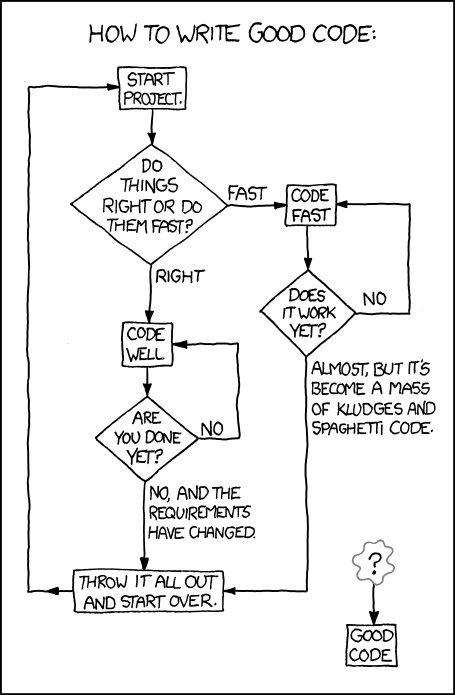
Whence programming greatness?

http://xkcd.com/844/
In programming -- probably in almost any creative field (Oh; how radical! Programming is creative! It's not just a modern form of manufacturing!?) -- technology is kinda important, so is that ethereal thing known as methodology. But towering over them in importance is people-ology. In fact, my primary itch in running a consulting firm is trying to dig into that idea, with implications such as "I'll take the best people, and mediocre programming tools and languages, you take the cool tools and languages and average people, and I Will Kick Your Bottom" (and spend less money). I spend a large part of my thinking time trying to develop answers to the following four questions:
  1. What are we trying to build? It's such an obvious question, I think sometimes we forget to ask it. Just what does an excellent person look like at any given stage in their development? What does their work product -- code, writing, effect on others -- look like?
  2. What are the pre-requisites? I reckon that some of the things that make for a superb programmer must already be in place at a young age. If you don't have those, I can't give them to you. (Nor would you want me to, since they're probably fairly basic aspects of character.) This is getting into the "10,000 hours of deliberate practice" stuff. But I need more detail. As Geoff Colvin explains in Talent Is Overrated: What Really Separates World-Class Performers from Everybody Else, 10,000 hours is merely the penultimate rung (the final one being the attainment of greatness itself) in a multi-rung ladder to performance. Achieving 10K hours itself, depends on passion. Passion, in turn, depends on a degree of confidence that the goal being sought is achievable (otherwise no one is going to go through the pain and suffering of the 10K hours in the first place). And even confidence isn't the bottom line. 
  3. What are proxies for (potential) greatness? The best way I know to see if someone is, or could become, really good is to work with them for at least a year -- longer if they're just fresh from university -- and see what they produce. But an internship is measured in only weeks or months, and those are only useful for youngsters. If I'm hiring an allegedly experienced person,  using a normal selection process -- interviews and stuff -- then my time is going to be measured in only hours or days. Now it may be that there's no good answer here other than the "work with them for a year and see" approach. But even if that's true, I'd still like some early indicators -- things I can spot in some kind of interview process -- that I may be onto a good thing. And just asking some cute puzzles is not, I think, enough.
  4. How do we amplify? So, we've agreed on what we're building, we know what a candidate has to bring to the table, and we've figured out a way of spotting it. Trouble is, the difference between a bright-but-inexperienced youngster (or even an experienced person but from a non-consulting job) on the one hand, and a battle-hardened Verilab consultant on the other is very large. So what do we do to turn potential into actual? Well, if "training" -- at least in the usual sense we mean it in Europe and North America -- is much more than about 10% of this answer, I'll be surprised. For various reasons, the education systems of said continents are substantially clueless when it comes to the challenge of taking high-potential technical youngsters, and turning them into high-actual technical professionals (in the best but rarely intended sense of that last word). Fixing that is probably the single best way to improve new product development the world over.
At first sight I guess those are statements of the blindingly obvious. But, as Feynman probably never said, "if you think you understand how to build greatness, you don't understand how to build greatness".


Tuesday, January 4, 2011

Big Yammer Is Watching You

Although I dealt them a minor slap, I'm really not trying to hammer Yammer (hoho). I like Yammer. I use Yammer. But I was browsing about, as I ponder if some kind of expanded "internal facebook" functionality would be useful for us, and I came across this presentation. It casts Yammer itself in that light, so in the spirit of love the one you're with I had a look to see if there were any additional features I could turn on in our account.

Well, we use the "silver" account, which I reckon is grandfathered. It's $3/month per user, compared with the $5/month version, called simply "Enterprise" on the pricing page, but called "gold" when I ask about upgrading to it from inside my account.

And so what would I get for an extra $2 a head a month? "Easy Data Export" Well that's useful I guess. Cloud-based apps that lock you in by making your data difficult or impossible to extract are uncool. "Multiple Email Domains". I suppose it could be useful, but I don't care about it for now.

But then the final extra-ness:

"Keyword Monitoring: Administrators can detect discussions about inappropriate or blacklisted topics."

I'm going to give them the benefit of the doubt and assume that either the madly litigious nature of America has forced them to provide this. Or larger clients (possibly for the same reason) have demanded it. But honest to geekdom, it's hard enough to get a rich culture of communication going in a business without tying the Big Brother Is Watching You albatross around your throat. Sigh.

Update: I just noticed that in my last Yammer-bash, I wrote jokingly: "ExCUSE me?? Would you like to add some bad-word catchers too while you're at it?" But as I say, I was j-o-k-i-n-g.

Friday, December 31, 2010

Co-lo

We've been going for just over ten years, and in all this time we've housed our own servers. Most of the work we do is either on-site at our clients, or back at base but using client hardware. So our own kit has been primarily for training purposes and running things like a Twiki.

However, primarily as a result of the pretty underwhelming experience we've had with so-called "business" grade internet from our local provider, we've decided to move our stuff to a local data center. In fact we took the opportunity to do a much needed upgrade of some core machines, and bought ourselves some Dell rack-mounted servers. We chose CoreNap in Austin. For $400/month we get 1/3 of a 72" cabinet, housed in a secure data center with 24x7 on-site support, heavy-duty a/c, multiply-redundant, clean power supply, and a chunk of bandwidth. So we get to ditch our cable service, UPS, spike protection, and an old rack we'd been using to house our PC towers.

So far so good. Should have done it years ago.

Wednesday, December 29, 2010

Page not found

One of my team pointed me at an old Joel Spolsky article on measuring software team goodness. I thought it very apt on finding what was on the end of the SEMA link that Spolsky mentions in the first line (but advises the reader against following).

Friday, December 17, 2010